Posted below are specific Scriptures that DIRECTLY reveal Jesus “IS
Jesus God...
There are MANY others that INDIRECTLY declare that Jesus “IS” indeed GOD.
I will open my presentation with the following question...
If Jesus was/is not GOD then how can He be worshipped as GOD whom God Himself commanded that ALL the angels of God should WORSHIP Him?
Hebrews 1:6 (KJV)
6
And again, when he bringeth in the firstbegotten into the world, he saith, And
let all the angels of God worship him.
Thus, if He is not God then this forces God to contradict His own Second Commandment — but yet Scriptures clearly declare that Jesus was/is “WORSHIPED” by many.
Exodus 20:3 (KJV)
3
Thou shalt have no other gods before me.
Exodus 34:14 (KJV)
14
For
thou shalt WORSHIP
no other god:
for the LORD, whose name is Jealous, is a jealous God:
Matthew 1:23 (KJV)
23
Behold, a virgin shall be with child, and shall bring forth a son, and
they shall call his name Emmanuel,
which being interpreted is, God with us.
Matthew 4:10 (KJV)
10
Then saith Jesus unto him, Get thee hence, Satan: for it is written,
Thou shalt worship the Lord thy God, and him only shalt thou serve.
Hebrews 1:6 (KJV)
6
And again, when he bringeth in the firstbegotten into the world,
he saith, And
let all the angels of God worship him.
Matthew 2:11 (KJV)
11
And when they were come into the house,
they saw the young child with Mary his mother, and fell down, and
worshipped him:
and when they had opened their treasures, they presented unto him gifts; gold, and frankincense, and myrrh.
Matthew 8:2 (KJV)
2
And, behold,
there came a leper and
worshipped him,
saying, Lord, if thou wilt, thou canst make me clean.
Matthew 9:18 (KJV)
18
While he spake these things unto them, behold,
there came a certain ruler, and
worshipped him,
saying, My daughter is even now dead: but come and lay thy hand upon her, and she shall live.
Matthew 14:33 (KJV)
33
Then
they that were in the ship came and
worshipped him,
saying, Of a truth thou art the Son of God.
Matthew 15:25 (KJV)
25
Then came she and
worshipped him,
saying, Lord, help me.
Matthew 28:9 (KJV)
9
And as they went to tell his disciples, behold, Jesus met them, saying, All hail.
And they came and held him by the feet, and
worshipped him.
Matthew 28:17 (KJV)
17
And when they saw him,
they
worshipped him:
but some doubted.
Mark 5:6 (KJV)
6
But when he saw Jesus afar off,
he ran and
worshipped him,
Luke 24:52 (KJV)
52
And they
worshipped him,
and returned to Jerusalem with great joy:
John 20:28 (KJV)
28
And Thomas answered and said unto him,
My Lord and
my God.
Isaiah 7:14 (KJV)
14
Therefore the Lord himself shall give you a sign; Behold, a virgin shall conceive,
and bear a son, and
shall call
his name Immanuel.
Revelation 1:20 (KJV)
20
The mystery of the seven stars which thou sawest in my right hand,
and the seven golden candlesticks.
The seven stars are the angels of the seven churches:
and the seven candlesticks which thou sawest are the seven churches.
Other Scriptures that directly call Jesus GOD are as follows:
John 1:1 (KJV)
1
In the beginning was the Word,
and the Word was with God, and
the Word was God.
John 1:14 (KJV)
14
And the Word was made flesh,
and dwelt among us, (and we beheld his glory, the glory as of the only begotten of the Father,)
full of grace and truth.
Revelation 19:13 (KJV)
13
And he was clothed with a vesture dipped in blood:
and his name is called The Word of God.
Matthew 1:23 (KJV)
23
Behold, a virgin shall be with child, and shall bring forth a son, and they
shall call
his name Emmanuel,
which being interpreted is,
God with us.
Isaiah 9:6 (KJV)
6
For unto us a child is born, unto us a son is given:
and the government shall be upon his shoulder:
and his name shall be called Wonderful, Counsellor,
The mighty
God,
The everlasting Father, The Prince of Peace.
Psalms 45:6–7 (KJV)
6
Thy throne, O God, is for ever and ever:
the sceptre of thy kingdom is a right sceptre.
7
Thou lovest righteousness, and hatest wickedness:
therefore God,
thy God,
hath anointed thee with the oil of gladness above thy fellows.
John 10:33 (KJV)
33
The Jews answered him, saying,
For a good work we stone thee not; but for blasphemy;
and because that thou, being a man,
makest
thyself God.
Acts 20:28 (KJV)
28
Take heed therefore unto yourselves, and to all the flock,
over the which the Holy Ghost hath made you overseers,
to feed the church of God,
which he hath purchased with his own blood.
1 Timothy 3:16 (KJV)
16
And without controversy great is the mystery of godliness:
God was manifest in the flesh,
justified in the Spirit, seen of angels, preached unto the Gentiles,
believed on in the world, received up into glory.
Titus 2:13 (KJV)
13
Looking for that blessed hope, and the glorious appearing of the
great God and our Saviour Jesus Christ;
Hebrews 1:3 (KJV)
3
Who being the brightness of his glory, and
the express image of his person,
and upholding all things by the word of his power,
when he had by himself purged our sins,
sat down on the right hand of the Majesty on high;
Hebrews 1:8
But about the Son he says,
“Your throne, O God”,
will last for ever and ever.
Not only is Jesus God but Jesus declares in Jn. 20:17 that YHWH is His GOD.
John 20:17 (KJV)
17
Jesus saith unto her, Touch me not; for I am not yet ascended to my Father:
but go to my brethren, and say unto them,
I ascend unto my Father,
and your Father;
and to
my God, and
your God.
1 John 5:20 (KJV)
20
And we know that the Son of God is come, and hath given us an understanding,
that we may know him that is true, and we are in him that is true,
even in his Son Jesus Christ. This is the true God, and eternal life.
2 Peter 1:1
...the righteousness of our God and Savior Jesus Christ
Meanwhile, the subscribers to and promoters of the misguided theology of "Unitarianism" advocate that respective to Psalms 110:1 the Hebrew word "Adoni" is used exclusively and defined in both Lexicons and Scripture as ONLY a "HUMAN Lord" or angel, and not the "DEITY Lord" Jesus Christ Himself. Thus, they ABOMINABLY declare as the nucleus of their doctrine, from this one single Passage (Ps. 110:1), that Jesus is unquestionably NOT God (the DEITY) but rather a mortal human "god/lord."
PLEASE note: the following commentary also reveals the FALSITY of the "Oneness/Jesus ONLY" doctrine as well — Ps. 110:1; Josh. 5:14 and Jdgs. 6:13 each reveal TWO Deity personalities, which are none other than LORD YHWH (God the Father) and Lord ADONI (Yeshua Jesus — God the Son).
Meanwhile, please see Deut. 6:4 for a complete
commentary on "God is ONE God" — but yet PLURAL Unity...
http://shalach.org/GodExists/deuteronomy_6.htm
The Hebrew word, ECHAD, in relation to Deut. 6:4 above,
“Jehovah our Gods is Jehovah ECHAD.”
Thus, it is indeed correct to translate Deut. 6:4 as,
"Jehovah our Gods is ONE Jehovah,"
only as long as we understand that ECHAD is to mean
"ONE" — Altogether
or in Unity,
but most certainly not ONE as an absolute singular numerical digit one.
Thus, ECHAD means to Unify or Altogether, as ONE
or in UNITY.
This usage of ECHAD, used as a Collective UNITY, is found HUNDREDS of TIMES
throughout the OT.
Thus, its most common use and meaning are well established.
To this end, when a Compound “one” is intended to be understood, ECHAD is the word of choice. For example, in Gen. 1:5, ECHAD is used to express the Oneness of Evening and Morning in One Day — “There was evening and there was morning, ONE day”; Likewise, the DUALITY of the ONENESS in Marriage, as cited in Gen. 2:24, “They two shall be ONE FLESH.” Moreover, it denotes a multi-unit in Genesis 11:6, “Behold, they are ONE people,” as well as several times in Exodus 26, “And thou shalt make fifty clasps of brass and put the clasps into the loops and couple the tent together that it may be ONE.”
Nonetheless, ECHAD is repeatedly the OT word of choice, used in such phrases as “ONE Cluster of Grapes” (Numbers 13:23), “ONE Company” (1 Samuel 13:17), “One Troop” (2 Samuel 2:25), “ONE Tribe” (1 Kings 11:13), “ONE Nation” (1 Chronicles 17:21), et al.
Going forwards, the Unitarians proceed to present their fraudulent case using the acclaimed Brown-Driver-Briggs Lexicon in which they only PARTIALLY represent the full and actual meaning of the Hebrew “Adoni” as published by the Brown-Driver-Briggs Lexicon...
In other words it is their premeditated intention to both defraud and to thereby deceive, because the information presented in the Brown-Driver-Briggs Lexicon is quite CLEAR regarding their intended definition of the Hebrew “Adoni.”
Therefore, my response to their insisted fraudulent claim is as follows:
Adonai and Adoni (Ps. 110:1) — The NT’s Favorite Old Testament Proof-text is based on an incomplete and partial representation of the published facts from the acclaimed and proven credible Brown-Driver-Briggs (BDB) Lexicon.
You presented the following from the published works of Brown-Driver-Briggs: (emphasis added):
Adonai and adoni are variations of Masoretic pointing to distinguish divine reference from human. Adonai is referred to God but Adoni to human superiors.
Adoni refers to men: my lord, my master [see Ps. 110:1]
Adonai refer refers to God — Lord (Brown, Driver, Briggs, Hebrew and English Lexicon of the Old Testament, under adon [= lord], pp. 10, 11).
However, as I have just stated, this is an incomplete and partial representation of the published facts of what Brown-Driver-Briggs actually state respective to their complete and formal definition of the Hebrew word Adoni.
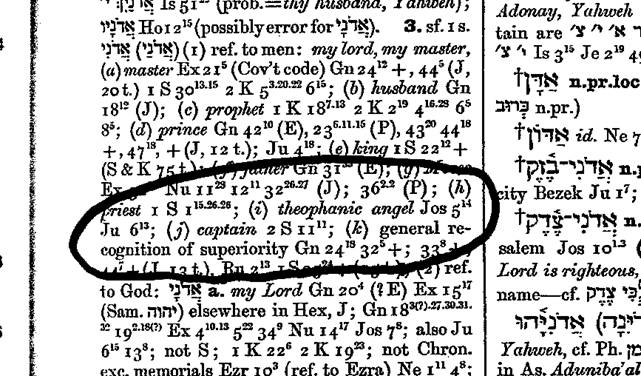
As such, I personally own this Brown-Driver-Briggs Lexicon, October 2006 printing publication (pp. 11), as well, and therefore posted below is a facsimile photo of the portion/part of the Brown-Driver-Briggs description/definition and Biblical usage for the aforementioned Hebrew word Adoni which you omitted. (pp. 11)
Please note that not only does Brown-Driver-Briggs declare what you have stated above, but they additionally state that according to BOTH Josh. 5:14 and Judges 6:13 (see circled section photo below — pp. 11) this Hebrew word Adoni equally means a Theophanic angel.
Therefore, a Theophany is defined as per Webster’s New World College Edition Dictionary (Oxford Dictionary being the same) as a supposed visible appearance of God or a god to man.
However, Unitarians eagerly itch to define the BDB‑stated THEOPHANIC (Theophany) as follows:
A manifested presence of a created non‑deity being (an angel) who represents and speaks on behalf of a non‑manifested and non‑present DEITY (God).
Their hope is nonetheless futile because there are NO legitimate dictionaries that define a “Theophany” as such — to the contrary, it is defined as a manifestation of a DEITY...
To this end, in any court of theological jurisprudence where the factual evidence evokes the judicial resolve, your case for the absolute and exclusive defined use of the Hebrew word Adoni as an insisted HUMAN Lord — and not the equally applicable and available, per Biblical Scriptural context, Theophany of the DEITY Lord — is hereby declared null and void.
In summary, the mere quantity (195, etc.) of the Biblical usage for any specific word (i.e. Adoni) does not, and hermeneutically cannot, based on sound theology, in and of itself mandate or validate a legitimate claim of exclusivity of one meaning superior to and silencing the equally available other(s) meaning(s) — especially where there is ample presented Scriptural evidence stating another valid meaning is indeed equally appropriate for a given word. In this case, the 2 usages in Josh. 5:14 and Judges 6:13 each present the solid evidence for the valid and appropriate application of the alternate meaning of the Hebrew Adoni — Theophanic angel of the DEITY Lord.
It MUST be noted that respective of Josh. 5:14, the great man of God Joshua — Joshua the great anointed general and leader of God’s people the Jews — fell on his face and WORSHIPPED this “Theophanic DEITY.” Had it not have been a DEITY then Joshua would have been worshipping a pagan god — a devil... God would have had the head of both him and the angel for such...
Moreover, the angelic DEITY LORD did NOT reject Joshua’s worship of HIM. Had this not have been a DEITY, but simply a created angel of God, he would have immediately voiced his rejection of Joshua’s worship of him.
Thus, your notion and insisted claim for absolute exclusivity for one specific and isolated meaning for the Hebrew Adoni (a HUMAN Lord) cannot even hope to factually stand and support your theology. Your notion is completely thwarted by the acclaimed and proven credible works of Hebrew Lexicons such as Brown‑Driver‑Briggs, Strong’s, et al., and the TWO witness Scriptures of Josh. 5:14 and Judges 6:13 — all of which publish and attest to the factual meanings that the Hebrew Adoni carries the multiple meanings of a HUMAN Lord AND equally the DEITY Lord as well.
To this end, your unsupportable notion and preponderance of evidence is completely defeated and undeniably proven without merit!!!
Therefore, ALL those who support this doctrine of a devil (Unitarianism) have NO hope of being SAVED — they DO NOT believe that Jesus IS God. Sadly, HELL will be their everlasting abode.
Going forwards, respective of the Lord adoni of Ps. 110:1, we see that this exact same verse is restated by Jesus in the NT in Matt. 22:44, Mk. 12:36, Lk. 20:42, and Acts 2:34. (emphasis added)
For example...
Psalms 110:1 (KJV)
The LORD said unto my
Lord,
Sit thou at my right hand, until I make thine enemies thy footstool.
Matthew 22:44 (KJV)
44
The LORD said unto my
Lord,
Sit thou on my right hand, till I make thine enemies thy footstool?
Thus, you will please kindly note that the Hebrew word in Ps. 110:1 is, as previously stated, the Hebrew adoni #113. Likewise, the Greek word in Matt. 22:44, Mk. 12:36, Lk. 20:42, and Acts 2:34 are all Kurio #2962 — with each used as a Greek noun‑dative‑singular‑masculine.
Therefore, the meaning of the Greek Kurio (Strong’s #2962) is as follows (emphasis added):
from kuros (supremacy); supreme in authority, i.e. (as noun) controller; by implication Mr. (as a respectful title): — God, Lord, master, Sir.
To this end, we can prove that David declared by the Spirit of God that the Lord of Ps. 110:1 and the Lord of Matt. 22:44, Lk. 20:42, and Acts 2:34 are indeed ALL defined references to a DEITY (the God) by the Passage of Lk. 2:22.
Luke 2:22 (KJV)
22
And when the days of her purification according to the law of Moses were accomplished,
they brought him to Jerusalem, to present him to the
Lord;
In the above Lk. 2:22 Passage Mary and Joseph are presenting Jesus to the Lord in Jerusalem in accomplishment of the Mosaic Law. The Greek word Lord (Kurio) used in this particular Passage is the SAME EXACT Greek word used for the Lord in Matt. 22:44, Mk. 12:36, Lk. 20:42, and Acts 2:34. It too is equally used as the EXACT SAME Greek Kurio #2962 as a Greek noun‑dative‑singular‑masculine.
It is very revealing and quite obvious in this Passage that Jesus as a baby was NOT presented to Himself — but rather to His Father YHWH God.
Therefore, the Greek word Kurio which is used here is indeed interchangeable for a DEITY (God), with each related to its own context — YHWH God vs. Jesus/Adoni God.
Following is a further correspondence on this same topic of the Hebrew “adoni.”
I would be VERY careful quoting the work or supporting sources of Anthony Buzzard regarding the Hebrew word adoni. Why?
It is Mr. Buzzard’s intended and misguided goal to prove that the Hebrew word
adoni is
exclusively used to define a non‑deity
(Human) ONLY and is equally expressed so in Ps. 110:1.
Therefore, he states the following:
ADONI
This is formed by adding the suffix “I” to
adon.
With this suffix it means my lord.
(It is also sometimes translated as “master.”)
It appears 195 times, and is used almost entirely of human lords (but occasionally of angels).
When translated “lord,” it always appears with a lower‑case “l”
(except for that one time in Psalm 110:1).
To this end, please allow me to direct your attention to Josh. 5:14 and Jdgs. 6:13, of which both use the Hebrew adoni and are BOTH declared by the credible and acclaimed Brown‑Driver‑Briggs (BDB) Lexicon, as I stated earlier, to be defined as a THEOPHANIC angel — a Theophany (please see facsimile photo of BDB p. 11 below).
As such, a Teophany is defined by Webster’s New World College Edition Dictionary (Oxford Dictionary, and MANY others) as a supposed visible appearance of God or a god to man.
Thus, with respect to your specific Ps. 110:1 Hebrew adoni vowel pointings — where is your cited Lexicon supporting evidence that specifically declares that the Ps. 110:1 Hebrew adoni is EXCLUSIVELY mandated to be understood as a non‑deity rather than a DEITY as is Josh. 5:14 and Jdges. 6:13? And PLEASE do not suggest the methodology of proof as the Scriptural quantitative use (195 times) of this said Hebrew word adoni as a basis for sound hermeneutical theological evidence, because it is quite obvious that Josh. 5:14 and Jdges. 6:13 are two specific exceptions of adoni examples that refute such a notion of translation by quantitative use.
Just ONE Scriptural exception of the Hebrew adoni nullifies any attempt to establish the Anthony mandate/requirement “law” declaring the adoni of Ps. 110:1 as specifically EXCLUSIVE to a Human and not to a DEITY.
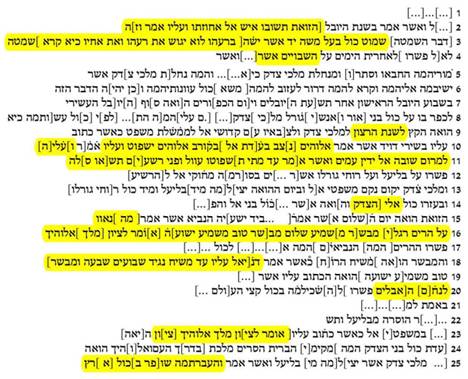
Meanwhile, Mr. Anthony Buzzard equally declares on his website in his article entitled
Adonai and Adoni (Psalm 110:1) as one of his cited sources of supporting evidence —
the following:
The form “to my lord,” l’adoni, is never used in the OT as a divine reference
the
generally accepted fact [is] that
the Masoretic pointing distinguishes divine references (adonai) from
human references (adoni)
(Wigram, The Englishman’s Hebrew and Chaldee Concordance of the OT, p. 22)
(Herbert Bateman, “Psalm 110:1 and the NT,” Bibliotheca Sacra,
Oct.–Dec., 1992, p. 438).
Here is an online link to his (this) cited source of The Englishman’s Hebrew and Chaldee Concordance of the Old Testament, Vol. 1, p. 22. (please scroll upwards to pg. 22) The Englishman's Hebrew & Chaldee Concordance of the OT
As such, you will quickly notice from the link above and my below posted personal facsimile photo copy of this said cited source — pg. 22, there is NO mention whatsoever of his supporting statement published by this author (Wigram)... (emphasis added) The vast majority — 99.9 percent — of Buzzard’s so‑called credible source comes from a “SINGLE” likeminded Baptist theologian named Herbert Bateman. The ONLY thing that Anthony uses from Wigram is simply the stating of the Hebrew word #136 “adonai” (not the Ps. 110:1 — #113 “adoni”).
Anthony simply rides the coattail of the established credibility of Wigram, BUT his real source is the personal writing of Herbert Bateman.
There are NO “The Englishman’s Hebrew and Chaldee Concordance of the OT”, Brown‑Driver‑Briggs, or any other creditable Lexicons to support his claim stated above — NONE... just the IMO’s of the likeminded Herbert Bateman.
Therefore, where then did Anthony actually get his aforementioned supporting statement from?
Meanwhile, as stated, I personally own The Englishman’s Hebrew Concordance of the Old Testament by George V. Wigram (Sixth Printing — April 2006) that Anthony cites above, and on p. 22 it makes NO such declaration respective of what he states in the following.
... generally accepted fact [is] that the Masoretic pointing distinguishes divine references (adonai) from human references...
Therefore, where then did Anthony actually get his aforementioned supporting statement from — it was most certainly NOT from these two sources?
In summary, once again with respect to your specific Ps. 110:1 Hebrew adoni vowel pointings suggesting a non‑deity to the absolute exclusion of a DEITY — where is your cited Lexicon supporting evidence that specifically declares that the Ps. 110:1 Hebrew adoni is EXCLUSIVELY mandated by definition to be understood as a non‑deity rather than a DEITY, as is clearly evidenced in Josh. 5:14 and Jdgs. 6:13?
Meanwhile, with respect to the prophecy of Mal. 3:1 and the Hebrew word “malak” (H4397), which is translated by the KJV and others as “MESSENGER,” but actually means “ANGEL,” the 2nd use of the Hebrew word “malak” refers directly to Jesus (the 1st “malak” refers to the PROPHET John the Baptist) and is declared by the credible BDB Lexicon to be a “THEOPHANIC angel.” Please note each Hebrew spelling of “malak” cited by BDB — the 1st a PROPHET and the 2nd a THEOPHANIC angel. Thus, revealing that among His other titles He is also an “ANGEL” — not as one of God’s created angels but one who declares and delivers the WORD “message” of His Father God to mortal mankind.
We must also keep in mind that the insisted distinction between adoni and Adonai was not actually present in the Hebrew Text when it was first written. This distinction is only expressed by the vowel points that were added to the text more than some 1000 years after the Text was originally written. There is no evidence whatsoever, of any kind, that this suggested distinction of adoni vs Adonai ever existed in Old Testament times.
This distinction between adoni and Adonai is nothing more than a group self‑righteous expression of the Masoretic pharisaical scholars who decided to divide one Hebrew word into two different words in order to uphold their own traditions! That is the only reason why we have today a distinction between adoni and Adonai.
Most people in the churches of God are not aware of how the Jews gymnastically alter things in the Hebrew Text that they want to change. Two of the most often used ways they achieve such unwarranted changes are referred to as qaryan we‑la ketivan (which means “read but NOT written” — i.e., they read something that isn’t in the Text) and as ketivan we‑la qaryan (which means “written but not read” — i.e., they deliberately do not read something that is actually contained in the written Text itself). Another way they achieve their desired changes in how the Hebrew Text is to be understood is by deliberately changing the meaning of certain Biblical Hebrew words. Simply give a word a totally new meaning, and you have a perfectly good explanation for your otherwise questionable IMO (in my opinion). This is a tactic the Tannaim and the rabbis of Talmudic times resorted to quite frequently and still do today.
Furthermore, please note the additional references by BDB to other Scriptural appearances of a THEOPHANIC angel as well.
Malachi 3:1 (KJV)
1
Behold, I will send my messenger,
and he shall prepare the
way before me: and the Lord, whom ye seek, shall suddenly come to his temple, even the
messenger of the covenant, whom ye delight in: behold, he
shall come, saith the LORD of hosts.
Brown‑Driver‑Briggs
b.
a prophet
Isaiah 42:19;
Isaiah 44:26;
2 Chronicles 36:15,16;
Haggai 1:13;
the herald of the advent
מלאכי
Malachi 3:1.
the theophanic angel ה֯א֠להים ׳מ in the story of E: Genesis 21:17; Genesis 31:11; Exodus 14:19, also in Judges 6:20; Judges 13:6,9; יהוה ׳מ in the story of J: Genesis 16:7,9,10,11; Genesis 22:11,15; Exodus 3:2; Numbers 22:22,23,24,25,26,27,31,32,34,35; and in Judges 2:1; Judges 2:4; Judges 5:23; Judges 6:11; Judges 6:12; Judges 6:21 (twice in verse); Judges 6:22 (twice in verse); Judges 13:3, 13, 15, 16 (twice in verse); Judges 13:17, 18, 20 (twice in verse); Judges 13:21; הַמַּלְאָךְ Genesis 48:16 (E); מַלְאָךְ Exodus 23:20 (E), Exodus 33:2; Numbers 20:16 (JE); Hosea 12:5; מַלְאָכִי Exodus 23:23 (E); Exodus 32:34 (J); מַלְאָכוֺ Genesis 24:7, 40 (J); פניו ׳מ Malachi 3:1 (referring to the ancient מלאך); הכרית ׳מ Malachi 3:1 (referring to the advent of ׳י for judgment, see BrMP 473). The theophanic angel is not mentioned in D and P.
In summary, ALL Hebrew OT Scriptures that reveal the “Angel of God” must be critically analyzed to determine if they are indeed a THEOPHANIC angel (CHRISTOPHANY) appearance of God Jesus — before He became the human man Jesus. With respect to Mal. 3:1 we also have the following quotation by Lange...
Who else could [Mal. 3:1] this be referring to but Jesus Christ? Concerning the term “the Angel of the Covenant” Lange writes: From a very early period we find mention of an extraordinary Messenger, or Angel, who is sometimes called the “Angel of God,” at others, the “Angel of Jehovah.”
He is represented as the Mediator between the invisible God and men in all God’s communications and dealings with men. To this Angel divine names, attributes, purposes, and acts are ascribed. He occasionally assumed a human form, as in his interviews with Hagar, Abraham, Jacob, Joshua, Gideon, Manoah, and his wife. He went before the camp of Israel on the night of the exodus. In Exodus 23:20, Jehovah said, “Behold, I send an angel before thee to bring thee into the place which I have prepared. My name is in him.”
In Isaiah 63:9 he is called “the angel of his Presence, or face,” where there is a reference to Exodus 33:14–15, where Jehovah said to Moses, “My Presence (or Hebrew, My face) shall go with thee,” and Moses said, “If Thy presence go not with us, carry us not up hence.” He is called the “face of God,” because though no man can see His face and live, yet the Angel of His face is the brightness of His glory, and the express image of His person. In Him Jehovah’s presence is manifested, and His glory reflected, for the glory of God shines in the face of Jesus Christ.
There is thus a gradual development in the Old Testament of the doctrine of the incarnation, of the distinction of persons in the Godhead, not brought to light fully, lest it should interfere with the doctrine of the unity of God...
All of the above information unquestionably proves the pre‑existence of God Jesus before He ever became the human man God Jesus. As stated above, God Jesus has been and is “WORSHIPED” by many.
Exodus 20:3 (KJV)
3
Thou shalt have
no other gods before me.
Exodus 34:14 (KJV)
14
For thou shalt worship no other god: for the LORD, whose name is
Jealous, is a jealous God:
Matthew 4:10 (KJV)
10
Then saith Jesus unto him, Get thee hence, Satan: for it is written,
Thou shalt worship the Lord thy God, and him only shalt thou serve.
Hebrews 1:6 (KJV)
6
And again, when he bringeth in the firstbegotten into the world,
he saith, And let all the angels of God worship him.
Isaiah 7:14 (KJV)
14
Therefore the Lord himself shall give you a sign; Behold, a virgin shall conceive, and bear
a son, and
shall call his name Immanuel
.
Revelation 1:20 (KJV)
20
The mystery of the seven stars which thou sawest in my right hand, and the seven golden
candlesticks. The seven stars are the angels of the seven churches: and the
seven candlesticks which thou sawest are the seven churches.
John 1:1 (KJV)
1
In the beginning was the Word, and the Word was with God, and
the Word was God.
John 1:14 (KJV)
14
And the Word was made flesh, and dwelt among us, (and we beheld his glory,
the glory as of the only begotten of the Father,) full of grace and truth.
Revelation 19:13 (KJV)
13
And he was clothed with a vesture dipped in blood: and
his name is called The Word of God.
